
Why I Recommend QuickBooks Online for Restaurants
Choosing accounting software is only the beginning. Learn why accurate bookkeeping, reliable financial reporting, and the right systems help restaurant owners make smarter business decisions.
QUICKBOOKSRESTAURANT


Running a restaurant means juggling dozens of moving parts every day. Between managing employees, keeping food costs under control, ordering inventory, serving customers, and handling payroll, bookkeeping is often the last thing on your mind—until something goes wrong.
I've talked with restaurant owners who know their dining room is full every night, yet they're still wondering where the money went. Others are spending hours every week entering receipts or trying to untangle transactions at tax time. Some aren't sure whether they're actually making a profit on their busiest menu items.
The truth is, restaurant bookkeeping differs from that of most other businesses. Restaurants have unique challenges like point-of-sale systems, tipped employees, delivery apps, inventory, gift cards, and constantly changing food costs. Those moving pieces require more than basic bookkeeping—they require financial information you can trust.
Having worked in restaurants myself, I know how quickly owners have to make decisions. There isn't time to dig through spreadsheets or wonder whether the numbers are accurate. You need organized, up-to-date financial information that helps you make confident decisions about your business.
That's where having the right bookkeeping system becomes so important.
Over the years, I've looked at many accounting solutions for small businesses. For restaurants, I keep coming back to QuickBooks Online—not because it's perfect, but because it provides a solid foundation when it's set up and used correctly.
The key isn't simply choosing good software. It's choosing software that works well with the other systems your restaurant depends on every day and provides reliable financial information you can actually use.
But here's something I tell every client: the software is only half the story.
Even the best accounting software can't replace accurate bookkeeping, thoughtful financial reporting, and someone who understands how restaurants operate. When QuickBooks is set up correctly and paired with consistent bookkeeping, it becomes much more than an accounting program—it becomes a tool that helps you make better business decisions with confidence.
In this guide, I'll explain why I recommend QuickBooks Online, where it shines, where it still benefits from a knowledgeable bookkeeper, and how the right combination can help restaurant owners spend less time worrying about their books and more time focusing on their customers.
The software is
only half
the story.
Restaurant owners wear more hats than almost any other business owner.
On any given day, you might be hiring a new employee, covering for someone who called in sick, placing food orders, checking inventory, handling customer concerns, reviewing schedules, or troubleshooting a piece of equipment that suddenly stopped working.
At the same time, the financial side of the business never takes a day off.
Payroll still needs to be processed. Vendor invoices need to be paid. Sales tax deadlines come and go. Food costs fluctuate, labor costs continue to rise, and cash flow can change dramatically from one week to the next.
Overwhelmed yet?
With so many competing priorities, it's understandable that bookkeeping often gets pushed to the bottom of the list. Most restaurant owners didn't open their business because they enjoy reconciling bank accounts or reviewing financial statements. They opened it because they're passionate about great food, great service, and creating an experience their customers will come back for.


Running a Restaurant Is Hard Enough—Your Bookkeeping Shouldn't Make It Harder.
The challenge is simple: Good decisions require good information.
Questions like these come up all the time:
Is the business actually making money?
Why does the bank balance look healthy, but cash still feels tight?
Are labor costs getting too high?
Is food waste eating into profits?
Which menu items are the most profitable?
Can I afford to hire another employee?
Is it time to increase menu prices?
One of the most common things I hear from restaurant owners is:
"We're busy every night, but it still feels like there's never enough cash."
A full dining room doesn't always translate into a healthy bottom line. Rising food costs, payroll, rent, merchant processing fees, delivery commissions, and other operating expenses can quietly chip away at profits. Without reliable financial information, it's difficult to know exactly where the money is going—or what changes will have the biggest impact. Without accurate, up-to-date financial information, those questions often become educated guesses instead of informed business decisions.
That's why restaurant bookkeeping isn't simply about keeping records for tax season. When done well, it provides the information owners need to understand what's happening in their business today so they can make better decisions tomorrow.
Restaurant Bookkeeping Isn't Like Other Businesses


At first glance, a restaurant might not seem much different from any other small business. Money comes in, bills get paid, employees are paid, and financial statements are prepared.
In reality, restaurant bookkeeping is much more involved.
Most restaurants rely on multiple systems working together every day. A point-of-sale (POS) system records sales, credit card processors deposit funds, payroll software calculates wages, inventory changes constantly, and delivery platforms introduce another layer of transactions and fees. Every one of those systems generates financial information that needs to be recorded accurately.
On top of that, restaurant owners have to keep an eye on metrics that many other businesses rarely think about.
For example:
Food cost percentage
Labor cost percentage
Prime cost
Average ticket size
Inventory usage
Menu profitability
Cash flow
These numbers tell the story behind the financial statements. They help answer questions like whether menu prices need adjusting, labor scheduling is efficient, or food costs are beginning to creep higher than expected.
That's why restaurant bookkeeping isn't just about recording transactions. It's about organizing financial information in a way that helps owners understand how their business is performing and where opportunities for improvement exist.
Why I Recommend QuickBooks as Part of a Good Bookkeeping System
Having worked in restaurants for decades, I know how quickly owners have to make decisions. There isn't time to dig through spreadsheets, chase down missing receipts, or wonder whether the numbers are accurate. You need financial information that's organized, current, and easy to understand.
That's one of the reasons I recommend QuickBooks Online to many of my restaurant clients. Not because it's the only accounting software available, and certainly not because it's perfect. I recommend it because it provides a solid foundation for accurate bookkeeping and works well with many of the systems restaurants already use.
One of the things I appreciate most about the platform is its ability to grow with your business. Whether you're running a fine dining restaurant, a neighborhood pub, a busy food truck, or expanding to multiple locations, the software has the flexibility to support you as your business evolves.
Perhaps most importantly, QuickBooks Online gives you access to financial reports when you need them. Instead of waiting until the end of the year to understand how your business performed, you can regularly review your Profit & Loss statement, Balance Sheet, Cash Flow Statement, and other reports that help you make informed decisions throughout the year.
Of course, software alone doesn't guarantee accurate financial information. The reports are only as reliable as the bookkeeping behind them.
That's why I view QuickBooks as a powerful tool—not a complete bookkeeping solution. When it's paired with accurate recordkeeping, regular reconciliations, and someone who understands restaurant operations, it becomes an important part of a bookkeeping system that helps owners make better decisions with confidence.
The reports are only as reliable as the bookkeeping behind them.
Bringing Your Restaurant Systems Together
One of the biggest advantages of QuickBooks Online isn't simply what it can do on its own—it's how well it works with many of the systems restaurants already rely on every day.
Think about all the technology your restaurant uses.
Point-of-sale system - Records sales.
Payroll software - Processes employee wages.
Bank account - Record deposits and payments.
Delivery platforms - Collect online orders.
Credit card processors - Transfer funds into your bank account.
Each of those systems tells part of your restaurant's financial story.
The challenge is bringing those pieces together into one complete picture.
The illustration below shows how those systems work together to create the financial information you rely on to run your restaurant.
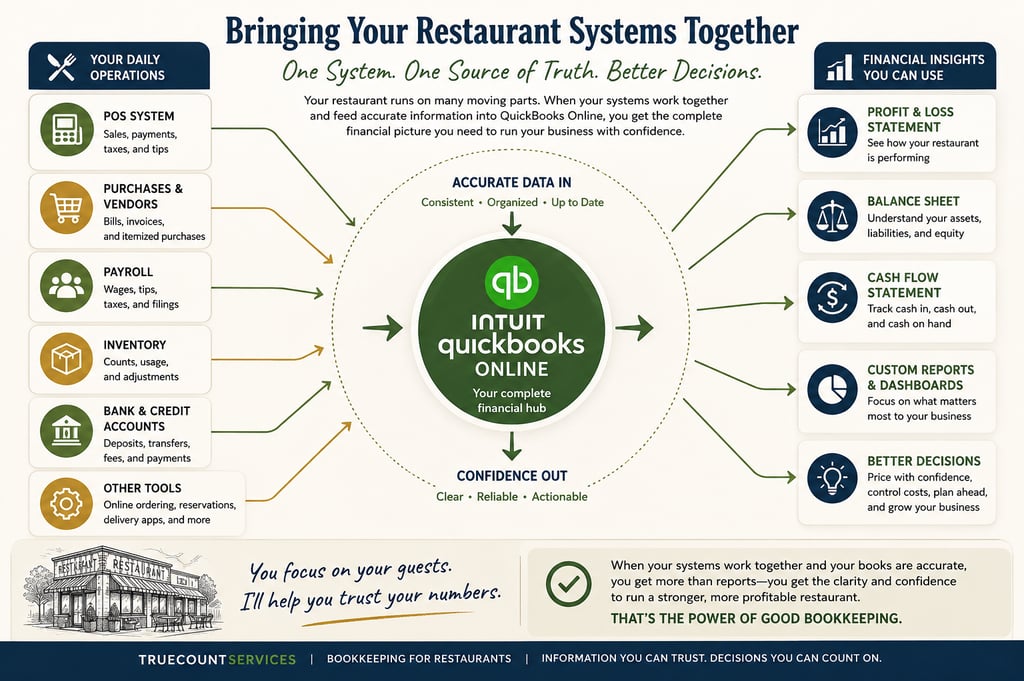
When your systems work together correctly, you spend less time worrying about whether your numbers are accurate and more time using them to make informed business decisions.
For many restaurants, that might include connecting QuickBooks Online with tools such as:
Toast
Square
Clover
Restaurant365
MarginEdge
xtraCHEF
Uber Eats
DoorDash
Grubhub
Not every restaurant uses every platform, and there's no one-size-fits-all setup. The right combination depends on how your restaurant operates and the information that's most important to you.
My goal isn't to recommend technology for the sake of technology. It's to help restaurant owners build a bookkeeping system that fits their business, reduces manual work where it makes sense, and produces financial information they can trust.
Automation Is Helpful—But It Isn't a Substitute for Good Bookkeeping
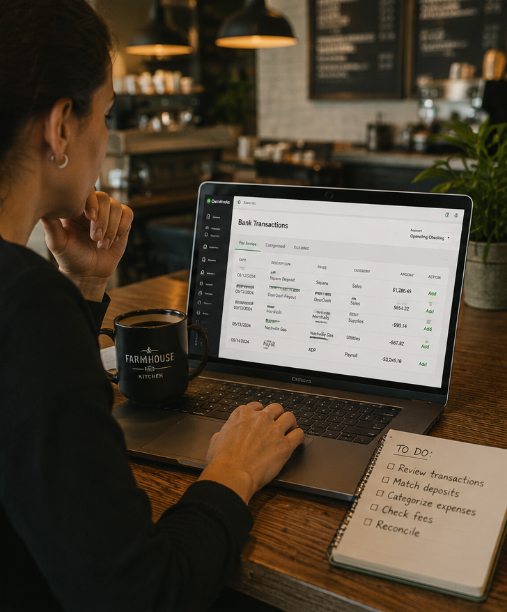
One of the reasons QuickBooks Online has become so popular is that it can automate many routine bookkeeping tasks. Bank transactions can be imported automatically, recurring transactions can be remembered, and connected systems can reduce the amount of manual data entry required.
Those features save time, and I'm a big believer in using technology where it genuinely helps.
What automation can't do is understand the story behind every transaction.
An expense might look like office supplies, but actually be equipment that should be treated differently. A deposit might include restaurant sales, tips, sales tax, and merchant processing fees that all need to be recorded separately. A receipt may need additional context before it can be categorized correctly.
Software can make recommendations, but it can't replace professional judgment.
That's why every transaction still deserves a second look. Accurate bookkeeping isn't about accepting every suggested category—it's about reviewing the information, asking questions when something doesn't look right, and making sure your financial reports reflect what's actually happening in your business.
This becomes even more important during catch-up or cleanup bookkeeping projects. When books have fallen behind or transactions have been categorized incorrectly, automation alone can't determine what should be corrected. Restoring accurate financial records requires careful review, attention to detail, and an understanding of how those transactions affect the financial statements.
Technology is a valuable tool, but it's exactly that—a tool. The real goal isn't simply to automate bookkeeping. The goal is to produce financial information you can trust when making decisions about your restaurant.Write your text here...
💡 Remember
Automation helps speed up bookkeeping.
Review ensures it's accurate.
The Financial Reports Every Restaurant Owner Should Understand


When your bookkeeping is accurate and your systems are working together, something valuable happens: your financial reports begin telling a clear story about your business.
Many restaurant owners think financial statements are something they only need at tax time. In reality, they're some of the most valuable tools you have for making day-to-day business decisions.
Here are the reports I encourage every restaurant owner to review regularly.
Profit & Loss Statement
Your Profit & Loss (P&L) statement shows how much your restaurant earned, what it cost to operate, and whether you made a profit during a specific period.
It's often the first report owners look at because it answers an important question:
"Is my restaurant making money?"
Balance Sheet
Your Balance Sheet provides a snapshot of what your business owns, what it owes, and what's left over after liabilities are paid.
While it doesn't get as much attention as the P&L, it helps you understand the overall financial health of your business.
Cash Flow Statement
A profitable restaurant can still struggle if cash isn't available when bills are due.
Your Cash Flow Statement helps explain where your money is coming from, where it's going, and whether your business is generating enough cash to support its operations.
Restaurant-Specific Metrics
Financial statements tell an important part of the story, but restaurants also rely on operational metrics such as:
Food Cost Percentage
Labor Cost Percentage
Prime Cost
Inventory Usage
Sales Trends
Average Ticket Size
These measurements help explain why your financial statements look the way they do and often highlight opportunities to improve profitability.
The goal isn't to memorize accounting reports or become a financial expert.
The goal is to have reliable information that helps you make confident decisions about pricing, staffing, purchasing, and growing your restaurant.
Common Bookkeeping Mistakes I See Restaurant Owners Make
Most bookkeeping problems don't happen because restaurant owners don't care about their finances. They happen because restaurant owners are busy.
When you're focused on serving customers, managing employees, and keeping the kitchen running smoothly, bookkeeping can easily become something you plan to "catch up on later."
Over time, those small delays can turn into much bigger problems.
Here are a few of the most common bookkeeping issues I see.
Waiting Until Tax Season
Bookkeeping provides the most value when it's done consistently throughout the year—not just when it's time to prepare taxes.
Waiting until year-end means you lose the opportunity to use your financial information to make better decisions along the way.
Relying on the Bank Balance
One of the biggest misconceptions is assuming that if there's money in the bank, the business must be doing well.
Your bank balance doesn't show unpaid bills, upcoming payroll, sales tax liabilities, loan balances, or other obligations. That's why financial reports provide a much clearer picture of your restaurant's overall financial health.
Mixing Personal and Business Expenses
Keeping business and personal expenses separate makes bookkeeping more accurate, saves time during tax season, and provides much more meaningful financial reports.
Assuming Automation Catches Everything
Automation is a tremendous time-saver, but it still needs oversight.
Software can make recommendations, import transactions, and remember previous entries, but it doesn't understand the context behind every purchase or deposit. That's why regular review is still essential.
Falling Behind on Reconciliations
Bank and credit card reconciliations help confirm that your bookkeeping matches what actually happened.
The longer reconciliations are delayed, the more difficult it becomes to identify errors and correct them accurately.
The good news is that every one of these challenges can be addressed. Whether your books are only a few weeks behind or several months out of date, putting a reliable bookkeeping process in place helps you regain confidence in your financial information and focus on running your restaurant.
Let's Build a Bookkeeping System You Can Trust


Every restaurant is different.
A neighborhood café has different bookkeeping needs than a multi-location franchise restaurant. A food truck operates differently than a full-service dining establishment. That's why I don't believe in one-size-fits-all bookkeeping.
My goal is simple: to help restaurant owners build a bookkeeping system that gives them confidence in their numbers.
Whether that means setting up QuickBooks Online, catching up months of overdue bookkeeping, keeping your books current each month, processing payroll, or simply helping you better understand your financial reports, I want you to have information you can rely on when making business decisions.
Bookkeeping shouldn't leave you wondering where your money went or whether your reports are accurate. It should give you clarity, confidence, and more time to focus on serving your customers.
If this guide has helped you better understand how restaurant bookkeeping works, I'd love the opportunity to learn more about your business and discuss how I can help.
Whether you're just getting started or looking for a better bookkeeping process, I'm always happy to have a conversation.
Schedule your free consultation today, because great restaurants deserve bookkeeping they can count on.
Bookkeeping shouldn't leave you wondering where your money went. It should give you clarity, confidence, and more time to focus on serving your customers.
Intuit, QuickBooks, and QuickBooks ProAdvisor are registered trademarks of Intuit Inc. used with permission under the QuickBooks ProAdvisor Agreement.