
Your Restaurant’s Bank Balance Doesn’t Tell the Whole Story
Your restaurant’s bank balance can tell you how much cash you have today, but it cannot tell you whether your business is truly profitable. Learn what restaurant owners need to look at instead.
RESTAURANTBOOKKEEPINGFINANCIAL STATEMENTS


Your restaurant’s bank balance can tell you how much cash you have today, but it cannot tell you whether your business is truly profitable. Learn what restaurant owners need to look at instead.
Many restaurant owners check their bank balance every day. Honestly, it makes sense. When you own a restaurant, cash is oxygen. You need to know whether there is enough money to cover payroll, food orders, rent, utilities, and those unexpected repairs that always seem to show up at the worst possible time.
So yes, your bank balance matters. But it does not tell the whole story.
Key Takeaway:
Your bank balance tells you how much cash is available today. It does not tell you whether your restaurant is profitable, whether costs are in line, or whether that cash is already committed to upcoming expenses.
Your bank balance tells you how much cash is available right now. It does not tell you whether your restaurant is actually profitable, whether your costs are creeping up, or whether the business is moving in the right direction.
That is where many restaurant owners get stuck. They look at the bank account and think,
“We must be doing okay.” Or worse, they look at it and think, “We are in trouble,” even when the business may actually be performing better than it feels.
The truth is that your bank balance is only one piece of the picture. To understand what is really happening in your kitchen and dining room, you need financial reports that are accurate, up to date, and organized for the unique way restaurants operate.
What Your Bank Balance Actually Tells You
Your bank balance answers one very limited question: How much cash is in the account right now? While that is useful information, it is not the same thing as financial clarity.
Your bank balance cannot tell you:
How much of that cash is already committed to upcoming expenses or outstanding checks?
Whether payroll taxes, sales tax, or vendor bills are still unpaid.
Whether food, beverage, or labor costs are too high relative to your sales.
Whether the business can safely afford a major purchase or expansion.
A restaurant can have money in the bank and still be losing money. Conversely, a restaurant can feel cash-tight during a busy growth season because expenses, payroll, and inventory timing are all moving at once. Relying only on the bank balance gives you a number, but it doesn't give you context.
A High Balance Can Be Misleading
One of the biggest risks of managing by bank balance is that cash can create a false sense of security.
For example, your bank account may look incredibly strong on Monday morning after a busy weekend. Sales were high, deposits came in, and the balance looks comfortable. But that same cash may need to cover a massive food delivery on Tuesday, payroll on Thursday, and a monthly rent or sales tax payment next week. Once those prime costs and fixed overhead hit, the picture changes quickly.
This timing mismatch is exactly why restaurants are so unique. Sales come in daily, but major expenses hit in waves. Without accurate books, it is almost impossible to know the difference between cash you can safely use and cash that is already spoken for.
A Low Bank Balance Does Not Always Mean Failure
The opposite is also true. A restaurant owner may look at a low bank balance and immediately feel discouraged, assuming the business is failing.
However, a low balance could simply mean a large inventory purchase just cleared, a quarterly tax payment was made, or payroll hit right before weekend deposits came in.
While a low balance should absolutely be taken seriously, the bank account alone cannot explain why it is low. When owners have only the bank balance to look at, they are left guessing—and that uncertainty creates intense stress. Good bookkeeping replaces that anxiety with actual information.
Profit and Cash Are Not the Same Thing
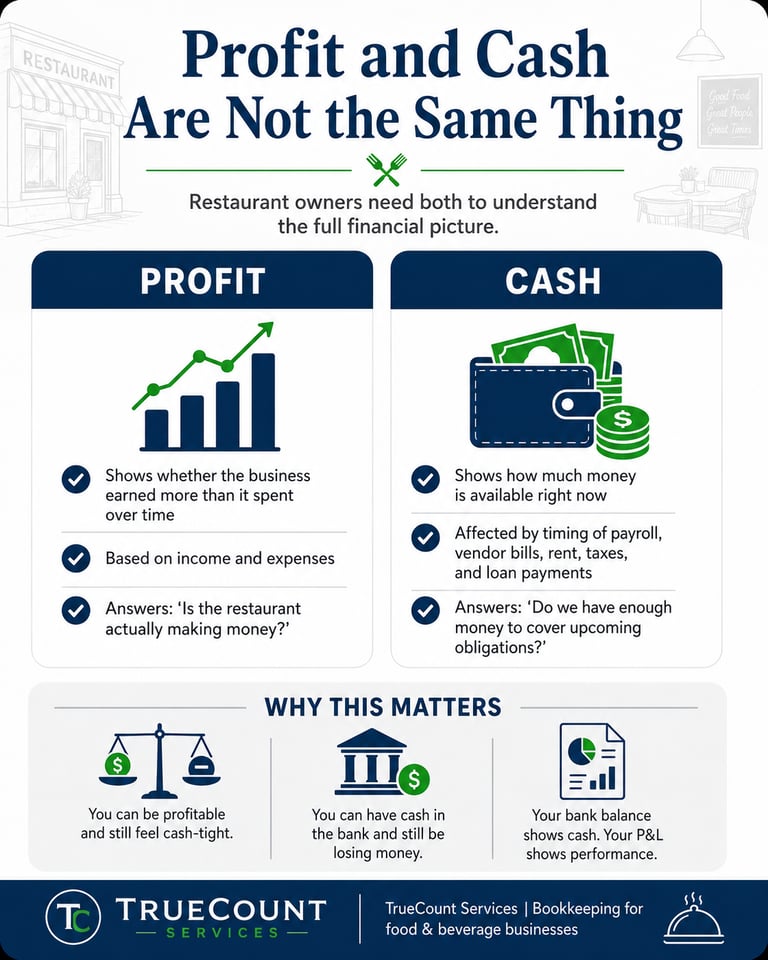
Cash and profit are not the same thing.
Cash shows what is available right now. Profit shows whether the business is earning more than it spends over time. A restaurant owner needs both pieces of information to make confident decisions.
Understanding the difference between profit and cash is a game-changer for restaurant owners. Profit tells you whether the business is earning more than it spends over time. Cash simply tells you how much money is available at a specific moment.
Because of timing differences, you can be highly profitable on paper and still face a temporary cash flow crunch. On the flip side, you can have plenty of cash in the bank this week while your food and labor costs are quietly eating away at your actual profitability.
This is why you need both. Your bank balance shows cash, but your Profit and Loss (P&L) statement shows performance.

Your P&L Tells the Bigger Story
A well-organized P&L helps answer the critical questions your bank balance ignores. It allows you to see:
Exactly where your revenue came from.
How much was spent on food, beverage, and labor (your prime costs).
Whether key operating expenses are increasing over time.
Whether sales growth is actually improving your bottom line.
For a restaurant, this matters because a busy dining room can still produce weak financial results if food waste is high, labor is overscheduled, or delivery app fees eat up your margins. A generic P&L might technically show income and expenses, but restaurant owners need more than a basic list of numbers. They need restaurant-specific context.
Restaurant Numbers Need Context
Restaurants are not like every other small business. You deal with daily sales, tips, comps, delivery app deposits, merchant fees, sales tax, inventory, and a constant flow of small transactions. If the books are not set up correctly, financial reports quickly become confusing.
When food, beverage, paper goods, and payroll are categorized consistently, you can finally answer the questions that drive real business decisions:
Are food costs creeping too high this month?
Is labor in line with our daily sales?
Are delivery app fees destroying our profitability on takeout?
Can we afford to hire another manager or upgrade our kitchen equipment?
The true value of good bookkeeping isn't just data entry or recording transactions—it is about transforming raw data into financial information you can actually use to protect your margins.
Clean Books Help You Make Better Decisions
Restaurant owners have to make decisions constantly. Should you change vendors? Should you raise menu prices? Should you expand hours or adjust your labor scheduling?
Those choices are incredibly difficult when your financial information is behind, messy, or unclear. When your books are current and organized, you can make decisions with confidence. You may not always like what the numbers show, but at least you are no longer guessing. For most owners, that clarity alone is a huge relief.
The Goal Is Clarity
Financial reports can feel intimidating, especially if no one has ever taken the time to explain them in plain language. But the goal isn't to bury you in spreadsheets. At a minimum, a healthy restaurant should consistently review:
An accurate, current Profit and Loss statement
Reconciled bank and credit card accounts
Clear, properly tracked payroll and labor cost information
Consistent categorization of food, beverage, and operating expenses
The goal is not more paperwork.
The goal is clearer information, cleaner reports, and less guessing when you make decisions about payroll, pricing, vendors, equipment, and growth.
When the books are clean and the reports are reviewed consistently, the numbers start to tell a clear story. And once you understand the story, you can respond to it effectively.
Your bank balance is a necessary starting point, but it isn't the whole picture. It tells you what is available today, but your bookkeeping explains how you got there and where you are going next.
Need Help Understanding What Your Restaurant Numbers Are Really Telling You?
TrueCount Services provides specialized bookkeeping support for food and beverage businesses throughout Middle Tennessee and beyond.
With deep experience in the restaurant industry and practical financial knowledge, TrueCount Services helps owners move beyond the bank balance to gain a clearer, more stress-free picture of their business finances.
If you are ready for clean books, clearer reports, and financial information you can actually use to grow, schedule a consultation today.